
Satellite Tribeca : Ballet Score for Strings and New Indie Classical
By SATELLITE COLLECTIVE
New York, NY 10013
Thursday, May 16, 7:00 - 8:30 pm
BALLET SCORE FOR STRINGS PREMIERE & NEW INDIE CLASSICAL
New York Premiere of "The Order of Things" ballet score for strings by Ellis Ludwig-Leone. Performed live, with a performance of his "Past Life" for violin, cello, and piano.
And three compositions by Will Healy, 2023 Leonard Bernstein Award Winner and Founder, SHOUTHOUSE. "Root Position", "Chimes", "Mariners" performed live with violin, viola, cello, and piano. Performers include Colin Brookes, George Meyer, Megan Atchley, and Thea Mesirow.
Tickets required, $20.
ABOUT THE EVENT
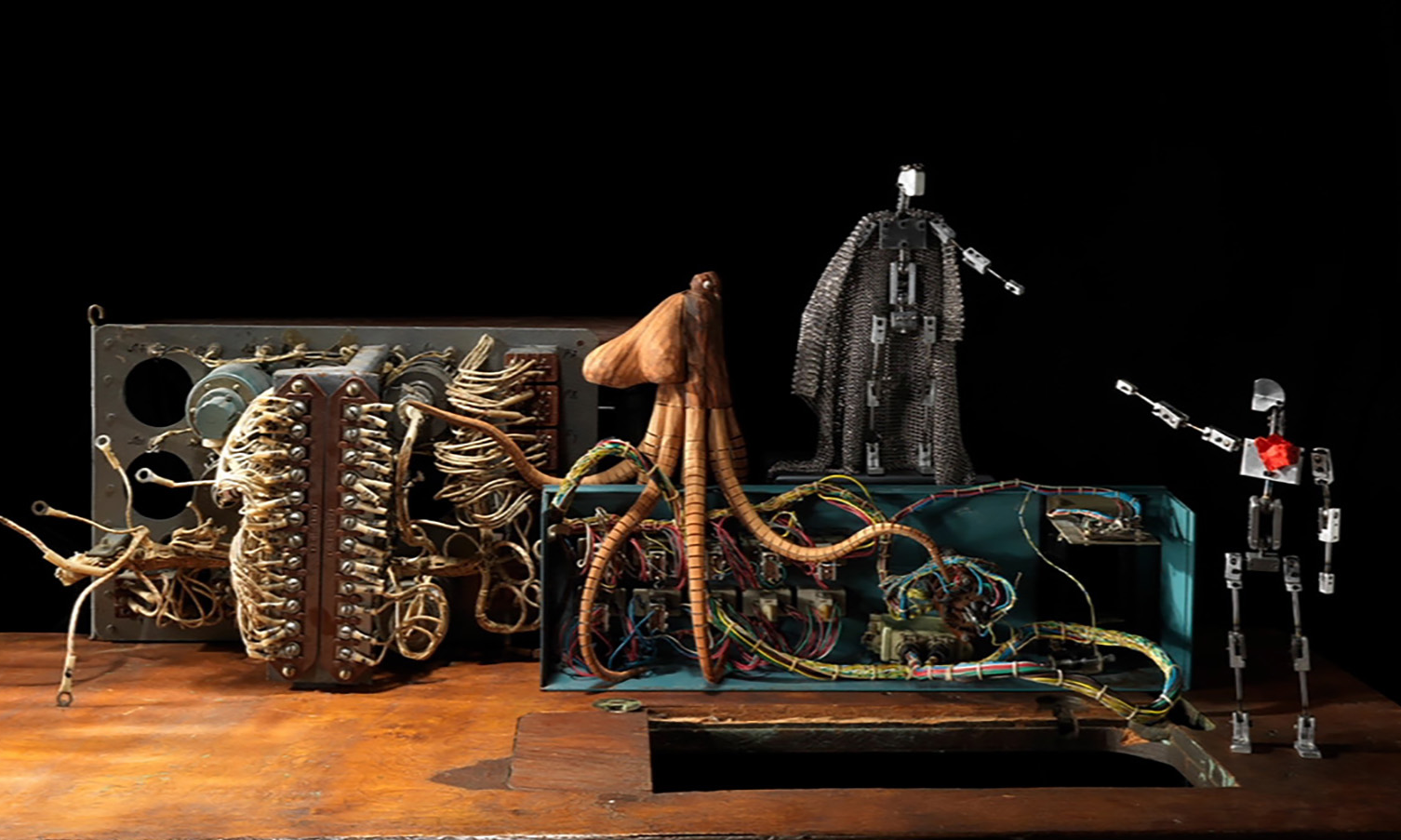
“The Order of Things,” a new work for string quartet by indie classical phenom Ellis Ludwig-Leone, is the score for the ballet Liar Lear King which premiered in 2022, co-produced by Grand Rapids Ballet with choreography by San Francisco Ballet Alum and Oregon Ballet Theater Artistic Director Danielle Rowe, and film and scenery by Kevin Draper and Lora Robertson. In the runup to the New York premiere of the full ballet, the full thirty minute score will be performed live at Satellite Gallery, 101 Reade Street.
Juilliard-trained composer and bandleader Will Healey will present solo piano work inspired by his Opus in development, Orbit - a piece that lays out a musical galaxy in which heavenly bodies interact, evolve, and eventually reach consciousness. Healy served as Music Director for the premiere of Aaron Severini’s score for “Echo & Narcissus” with Satellite Collective at BAM Fisher in 2018. This new work draws from Healy’s compositional experiments with hip-hop, jazz, and classical music.
Satellite Collective Presents:
Music by Will Healy & Ellis Ludwig Leone
The Mriya Gallery
May 16th, 2024
Mariners (2022) . . . . . . . . . . . Will Healy (b. 1990)
Megan Atchley, violin
Colin Brookes, viola
Will Healy, piano
Root Position . . . . . . . . . . . . . . Will Healy
I. Suspension Bridges
II. Pedal Point, Waiting
III. Amen Escalator
George Meyer, violin
Colin Brookes, viola
Thea Mesirow, cello
Will Healy, piano
Past Life . . . . . . . . . . .Ellis Ludwig-Leone (b. 1989)
George Meyer, violin
Thea Mesirow, cello
Will Healy, piano
Chimes (2016, arr. for violin, cello and piano in 2024) . . . . Will Healy
Megan Atchley, violin
Thea Mesiro, cello
Will Healy, piano
The Order of Things (2022) . . . . . . .Ellis Ludwig-Leone
George Meyer, violin
Megan Atchley, violin
Colin Brookes, viola
Thea Mesirow, cello
Program Notes:
Mariners (2022)
I began writing “Mariners” in a small town in Italy, where I was doing my best to write nothing at all. I had been composing continuously for a few months through the cold, dark New York winter, and had been looking forward to a vacation. I was playing Chopin at the piano in my room at the Bogliasco Foundation, near the city of Genoa, and was struck by the beauty of the setting. The doors were open to the ocean and azure blue stretched far into the horizon. I began improvising some simple textures, imitating the layers of melody and harmony in Chopin’s preludes. Back in Brooklyn, where I could hear the foghorns from the harbor miles away reverberating through my apartment, I thought about that setting often. That is where the piece was completed. It was premiered in Door County, Wisconsin, at the Midsummer’s Music Festival in July 2022.
Past Life (Ellis Ludwig-Leone, b. 1989)
The idea for this piece came from an experience I had in Nijmegen ducking off a busy
street and into a dark chapel. There were two men reciting an evening prayer in the
corner, and it was moving to inadvertently trespass on this intimate, ancient ritual softly
existing in the middle of a modern city. It got me thinking about the history of the spaces
we inhabit, both physically and musically. The first part of the piece imitates that noisy
street: the buzzing energy and the not-quite-finished sentences overheard as people
rushed past. The second part centers on a quiet call and response that winds into a
shared melody.
Root Position (Will Healy, b. 1990):
I. Suspension Bridges
II. Pedal Point, Waiting
III. Amen Escalator
As a composer, I spend a lot of time thinking about how to tell stories without words and how certain notes and chords can give the listener a specific feeling. In 2022-2023, I had the chance to play five concerts of Bach Cantatas, accompanying a professional choir in New York, with the nearly impossible task of covering all of the orchestral parts on one piano. It was a great and challenging experience, allowing me to study a large body of Bach’s work that pianists do not generally get to perform. Each of the cantatas contains multiple chorales, which are simple, four-voice passages intended to be sung by the church congregation.
When I started writing this piece for Midsummer’s Music in Door County Wisconsin, I was very interested in those chorales, and my apartment building in Brooklyn was getting frequent chorale concerts each morning through the walls. Each of the movements in “Root Position” reflects on one of the harmonic techniques that Bach employs in those chorales. The first movement considers suspensions, which are dissonances that resolve to a consonance, with sliding notes that smoothly lead us from one harmony to the next. The second movement contains a long “pedal point”, which is a note that remains the same below changing harmonies. This note builds tension, a drone that exists below harmonies that increasingly clash with it. The third movement reflects on the IV-I cadence, a common compositional technique that is recognizable as the “Amen” harmonic progression. In all of Bach’s chorales, the harmonic progression is often searching for, traveling from, and heading to a certain harmony, the “root position” chord, which is a simple, three-note chord that has the tonal center as the lowest note. As I wrote, I thought about the parallels between these harmonic progressions and human feelings and emotions.
Chimes (2016, arr. for violin, cello and piano in 2024)
In 2016, I wrote a piece called “Speaking” for soprano saxophone and piano, with each movement inspired by some type of dialogue between the instruments. I arranged “Chimes”, the third movement, for violin, cello, and piano in 2024. In this piece, I imagine a conversation among inanimate objects, inspired by the sound of wind chimes on my grandmother’s porch in the Berkshires. The piece begins with the sound of chimes echoing within the ensemble, and an imagined dialogue floats in and out in the middle section of the piece.
The Order of Things (2022)
The Order of Things is the score to Liar Lear King, a ballet choreographed by Danielle Rowe and commissioned by Satellite Collective in 2022. The ballet follows the five acts of King Lear, beginning with his challenge to his daughters and ultimately leading to his madness and undoing. Because the ballet is narrative, the music is loosely programmatic as well: the cello mapped to Lear’s stormy, sorrowful presence; the first violin channeling Cordelia’s sweetness and warmth; the second violin and viola giving voice to the other bickering sisters. When I’m writing for string quartet, I often think of the group as a family in conversation: shouting, whispering, agreeing, interrupting. But it’s rare I get the opportunity to do it so literally, and with such a famous family.
Liar Lear King explores themes of narcissism and bullying, and their impact on our families.
To hear the official recording of “The Order of Things'' and see the premiere performance of the ballet follow this link: https://www.youtube.com/watch?v=lIyQqx6jInE&t=221s
Need help? Email support@givelively.org

© Give Lively LLC 2026. All Rights Reserved.