
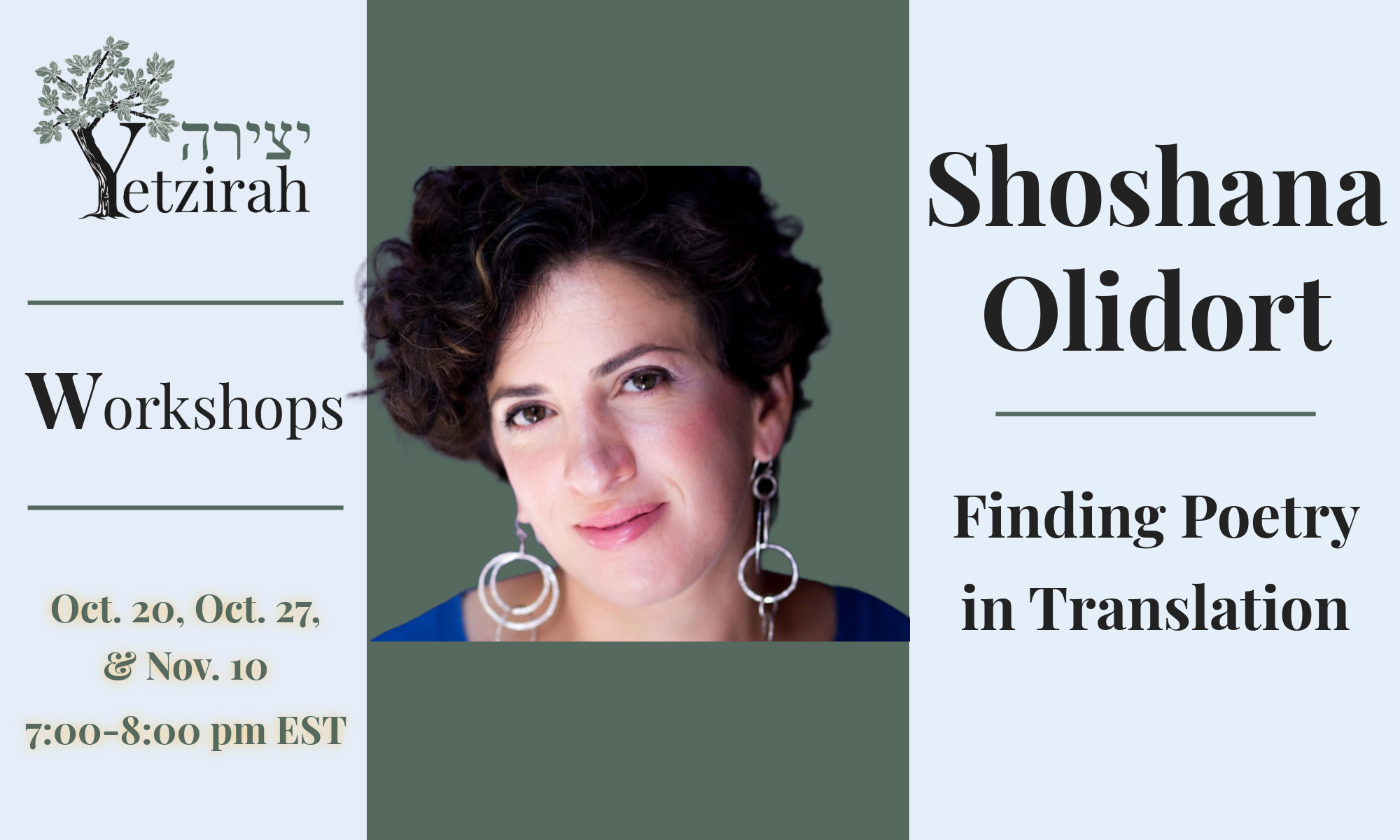
Finding Poetry in Translation with Shoshana Olidort
By Yetzirah
Link will be included in email receipt
Finding Poetry in Translation: A Three-Part Workshop
The poet/translator/translation theorist Mireile Gansel has said that “no word that speaks of what is human is untranslatable.” On the other end of the spectrum, we have the observation, attributed to Robert Frost, that “poetry is what gets lost in translation.” In this workshop, we’ll explore a range of approaches to translation and translability, and create new translations both individually and collaboratively. Keeping in mind Walter Benjamin’s insistence that “all great writings [. . . ] contain their potential translation between the lines,” we’ll consider what translation makes possible in the world, how it not only serves new readers in a target language, but also enriches the original text, pushing language against its own limits to expand meaning in new and unexpected ways.
Readings may include poems by Almog Behar, Paul Celan, Celia Dropkin, Dan Pagis, Esther Raab, and Avrom Sutzkever, among others.
Second language not required.
Shoshana Olidort is a critic, writer, and translator. Her work has appeared in Asymptote, The Cortland Review, Electric Literature, The Laurel Review, Literary Hub, The Los Angeles Review of Books, Public Books, and The Times Literary Supplement, among other outlets. She holds a PhD in Comparative Literature from Stanford University.
** If this fee is a hardship, Yetzirah offers a pay-what-you-can option for workshop participation. No one will be turned away for lack of funds, but please contact Program Coordinator Kyra Lisse at klisse@yetzirahpoets.org if you would like a sliding-scale ticket.
Yetzirah is a nonprofit organization, and any gift you make is tax-deductible to the extent allowed by the law.
Need help? Email support@givelively.org

© Give Lively LLC 2026. All Rights Reserved.